Sunday, February 18, 2018

Book Review: Devotional Fitness, by Martin Radermacher

When it comes to society today, one of the things that we value above all is physical fitness. Many websites and books are dedicated to this very topic. This book, while about fitness, also explores the religious side of physical fitness and the role that religion plays in people exercising in their daily lives.

Chapter 1 of this book is merely the introduction to the book itself. Part 1 gives the background to the research with chapter 2 covering previous works on the topic and chapter 3 giving the goal, theory, and method of this specific work. Part 2 dives into the research material, with chapter 4 looking at how the ideal body has been shaped through the years and chapter 5 detailing a history of how evangelicals have viewed and used the physical body through history. Part 3 is an analysis of all that has been mentioned previously. Chapter 6 gives practical resources to implement better practices of devotional fitness. Chapter 7 looks at the environments that this devotional fitness exists in. Part 4 gives some concluding remarks in two chapters, with chapter 8 reconsidering the results that have been found and chapter 9 giving the final word of the book.

This book presents some interesting thoughts. I feel that the church should do different physical things to help reach out to their community and to improve the health and well-being of the church itself. This book will present me with some things to think about as I venture into full-time ministry. For these reasons, I give this book 4 stars out of 5.

WHERE TO BUY THIS BOOK:
http://www.springer.com/us/book/9783319498218

BIBLIOGRAPHY OF THIS BOOK:
Radermacher, Martin. Devotional Fitness: An Analysis of Contemporary Christian Dieting and Fitness Programs. Cham, Switzerland: Springer International, 2017.

DISCLOSURE OF MATERIAL: I received a complimentary copy of this book through the Springer book review program, which requires an honest, though not necessarily positive review. The opinions I have expressed are my own. 

Friday, February 16, 2018

Book Review: Dickens, Religion, and Society, by Robert Butterworth

Charles Dickens was one of the most prolific authors of his time. Many of his stories are still read today. Here’s the kicker though—many of his stories also had religious undertones. This book explores Dickens’ takes on religion as well as society.

Chapter 1 specifically looks at Dickens and religion. Chapter 2 looks at his responses to the Christian social attitudes of his day. After these introductory chapters on Dickens and religion, the next 5 chapters are spent covering individual books on this topic:

  • Chapter 3—Oliver Twist
  • Chapter 4 introduces the next three books.
  • Chapter 5—Bleak House
  • Chapter 6—Hard Times
  • Chapter 7—Little Dorrit

Chapter 8 transitions from religion to society, with a specific look at Dickens and politics. 2 more books are covered in this section:

  • Chapter 9—Barnaby Rudge
  • Chapter 10—A Tale of Two Cities

Chapter 11 concludes the book with Dickens and sentimentality and what it really meant to him.

I felt that this book was an interesting perspective on Dickens. The religion of authors often plays a huge role in their writing, and this did not change for Dickens. Societal perspectives also contribute to writings and Dickens was a master of using and abusing society in his writings. For these reasons, I give this book 4 stars out of 5.

WHERE TO BUY THIS BOOK:
http://www.springer.com/us/book/9781137558701 

BIBLIOGRAPHY OF THIS BOOK:
Butterworth, Robert. Dickens, Religion, and Society. Cham, Switzerland: Springer International, 2016.

DISCLOSURE OF MATERIAL: I received a complimentary copy of this book through the Springer book review program, which requires an honest, though not necessarily positive review. The opinions I have expressed are my own. 

Thursday, February 15, 2018

Book Review: Thanks for Asking, by Mike Larsen

Questions Asked, Questions Answered

We live in an age of questions. If there is a topic to discuss and a question to ask, we tend to ask that question. Things of God are no exception to this. Mike Larsen, the pastor of Encounter Christian Church in Bellflower, California, allowed the people of his church to ask him and his staff questions. These questions turned into a sermon series and eventually this book.

This book seems to be written directly from the sermons that were given. The style is very sermonic, and thus, very conversational. Rather than becoming a high and mighty discussion of certain topics, Larsen brings the topics discussed right to where the layman can understand.

The topics discussed are:
  • Evil
  • Alcohol
  • Divorce
  • Homosexuality
  • God's will
  • Religions
  • God's judgment
  • Suffering
Questions are often asked about all of these topics, and through Biblical study, Larsen does a good job of answering these questions. He is very thorough in his analysis of each issue and presents very good illustrations to show how the principles can be applied.

Personally, I found this book to be a very good resource for me as a future pastor. It's not because I could take each of these chapters and preach it straight as a good sermon, although that could probably be true (NOTE: I never plan to do that and plagiarize this great work). But for me as a future pastor, this great book is an example of how to handle very difficult questions. For these reasons, I give this book 4.5 stars out of 5.

WHERE TO BUY THIS BOOK:


BIBLIOGRAPHY OF THIS BOOK:
Larsen, Mike. Thanks for Asking: Equipping God's People with Answers to Life's Tough Questions. Houston, TX: Lucid Books, 2018.

DISCLOSURE OF MATERIAL: I received a complimentary copy of this book from Lucid Books, in exchange for an honest, though not necessarily positive review. The opinions I have expressed are my own. 

Book Review: Can God Defeat Terrorism?, by Scott Solana

A legitimate question with Biblical answers

When we consider our world, we often think about the constant terrorist threats that arise. We fear ISIS, Al Qaeda, and other groups that have threatened our country and our military. It is only natural to then ask the question, "Can God defeat terrorism?" Through examples from the books of Jonah and Nahum, Scott Solana finds that God has defeated terrorism and can do it again.

In these 2 books, the nation of Assyria is the Biblical terrorists. Their rule and conquest were characterized by turmoil and torture. What we would consider terrorism now, was what they did on a daily basis to Israel, Ammon, Moab, and any other nation that was living in the Middle East. But God, through His great grace in Jonah and His great power in Nahum, was able to defeat that terrorism.

This book was a new look for me. I had never considered that Assyria was truly a terrorist nation. But this provides a new perspective for me on what God wants to do with those people. He wants to show them His grace, just as He did for Nineveh. For these reasons, I give this book 4.5 stars out of 5.

WHERE TO BUY THIS BOOK:
https://www.amazon.com/Can-Defeat-Terrorism-Scott-Solana/dp/1633570576/ref=sr_1_1?ie=UTF8&qid=1518722738&sr=8-1&keywords=can+god+defeat+terrorism

BIBLIOGRAPHY OF THIS BOOK:
Solana, Scott. Can God Defeat Terrorism?. Colorado Springs, CO: CrossLink, 2017.

DISCLOSURE OF MATERIAL: I received a complimentary copy of this book through the Book Crash book review program, which requires an honest, though not necessarily positive review. The opinions I have expressed are my own.

Book Review: The Air I Breathe, by Louie Giglio

When I think of my life, I truly believe that the one word that must describe it in everything I do is worship. Louie Giglio feels the same way. As the founder of the Passion movement, he has seen worship grow and change for years. Yet here in this book he defines what worship truly is.

This book makes worship into a lifestyle, as it should be. Every person on the planet is programmed to worship. What we choose to worship is up to us. Giglio does a good job in teaching about putting our focus on Christ in our worship. While this is not the best book on worship that I have ever read, it is a good one. Giglio's book poses good questions to us in worship (literally, with group discussion questions at the end). For these reasons, I give this book 3.5 stars out of 5.

WHERE TO PURCHASE:
https://www.amazon.com/Air-Breathe-Worship-Way-Life/dp/0735290717/ref=sr_1_1?ie=UTF8&qid=1518721516&sr=8-1&keywords=the+air+i+breathe+louie+giglio

BIBLIOGRAPHY OF THIS BOOK:
Giglio, Louie. The Air I Breathe: Worship As a Way of Life. Colorado Springs, CO: Multnomah, 2017.

DISCLOSURE OF MATERIAL: I received a complimentary copy of this book through the Blogging for Books book review program, which requires an honest, though not necessarily positive review. The opinions I have expressed are my own.

Tuesday, February 13, 2018

Book Review: The American Exception, Volumes 1 & 2, by Frank J. Lechner

America—an exceptional nation. This is the basis of this series of books. I have included both volumes of this book in the same review because they really do flow together. Frank J. Lechner in these 2 books looks at perspectives on the thinking that the American nation is truly exceptional.

VOLUME 1: Chapter 1 introduces the idea of the “American Exception.” While it is often easy to define America as exceptional, there are others who would scoff at this. Therefore, it is important now to study the exceptional nature of America. Chapter 2 looks at the different perspectives that people have on the American Exception. These perspectives are the American perspective, Tocqueville’s perspective, the Socialist perspective, and the Anti-American perspective. Chapter 3 looks at the American Exception regarding religion. Megachurches, evangelicalism, civil religion, and missions are all discussed. Chapter 4 deals with the American Exception and the law. Capital punishment, adversarial legalism, the Constitution, and the U.S. in international law are all topics under examination. Chapter 5 is the last chapter of volume 1 and looks at the American Exception in sports. Baseball, football, racial issues, and world sports are discussed at length in this chapter.

VOLUME 2:Chapter 1 of the second volume continues by looking at the American Exception in the realm of economics. Housing, financial market growth, opportunity and mobility, and the U.S. in world economics are all looked at here. Chapter 2 delves into the American Exception in different government programs. Healthcare, welfare, citizenship regarding race, and immigration are all looked at here. Chapter 3 looks at the American Exception in the media. Music, TV, media moguls, and the U.S. in global movies are all looked at. The final chapter of these 2 books is the American Exception in America’s power. The war on terror, military force, America’s mission, and the U.S. in the global empire are all looked at here. 

Since I reviewed 2 books for this, rather than out of 5 stars, I will rate these books out of 10. America is truly an exceptional nation, but we have much work to do to keep it that way. These books provide good perspectives on that. For these reasons, I give these books 8 stars out of 10.

WHERE TO BUY THIS BOOK:
http://www.springer.com/us/book/9781137587169 AND http://www.springer.com/us/book/9781137587190

BIBLIOGRAPHY OF THIS BOOK:
Lechner, Frank J. The American Exception, Volumes 1 & 2. Cham, Switzerland: Springer International, 2017.

DISCLOSURE OF MATERIAL: I received a complimentary copy of this book through the Springer book review program, which requires an honest, though not necessarily positive review. The opinions I have expressed are my own. 

Monday, February 12, 2018

Book Review: The Ulysses Delusion

What makes a good novel good? This is the question presented by Cecilia Konchar Farr in The Ulysses Delusion. For too long there has been a consensus that has remained unchallenged. There are novels on best-seller lists and in other places that Farr questions the positioning of. Her point in writing this book then is this: “I just want us to start talking, authentically, realistically (xix).” So, let’s talk, and see what we can find an answer to our initial question.

Section 1, “The Crime,” deals with the crime that has become literary criticism. Farr attempts to right that crime. In chapter 1, Farr argues for a different take on criticizing the novels that we read. Chapter 2 delves into the class biases that inherently exist in the novels that we choose. Section 2 then takes principles and goes into case studies. These are studies on:
  •  Chapter 3 – Lolita      
  •  Chapter 4 – Oprah’s Book Club      
  •  Chapter 5 – “Chick Lit”      
  •  Chapter 6 – 50 Shades      
  •  Chapter 7 – Jodi Picoult     
  •  Chapter 8 – Atlas Shrugged      
  •  Chapter 9 – Harry Potter      

Section 3 is composed only of Chapter 10, which presents Farr’s final goal of this book- a new way of book critiquing. Her emphasis here is clear: find out why you think a book is good. I have to agree here. Not all the books that I have reviewed are good. I have not enjoyed them all. Some of them are by good authors, yet I have not liked them. But we must each decide why we think a book is good. For this reason, I give this book 4 stars out of 5.

WHERE TO BUY THIS BOOK:
http://www.springer.com/us/book/9781137553621

BIBLIOGRAPHY OF THIS BOOK:
Konchar Farr, Cecilia. The Ulysses Delusion: Rethinking the Standards of Literary Merit. Cham, Switzerland: Springer International, 2016. 

DISCLOSURE OF MATERIAL: I received a complimentary copy of this book through the Springer book review program, which requires an honest, though not necessarily positive review. The opinions I have expressed are my own. 

The End of Our Rights

As Americans, we know our rights. Nothing is more precious to us in the world than the rights and freedoms that we hold dear. Those rights were fought for and hard earned. As Americans, we desire to live our lives to the fullest and use our rights to the fullest. But are we willing to sacrifice our rights for others?

You see as I have lived more of life, I have found that we as Americans sometimes get so concerned with OUR right that we fail to think of others. We think of our right to say what we want, yet we ignore the right of another to privacy. We think of our right to publish what we want on our social media, but do we truly value our relationships with others when considering what we will post? This is just not Americans though. 

This is Christians. 

We exalt our right to wear something but don’t think about the person who may be tempted to sin by just looking at us. We exalt our right to listen to whatever we want but don't think about the person who associates what we are listening to with the sinful actions of his past. We, too exalt our right to speak our minds but do not think of the reputation that we are giving to Christ by running our mouths. 

When will we learn? When will our relationships with our brothers in Christ become more important than personal right? When will the name of Christ become our priority in life, rather than a petty feud over what we're putting out on our social media? Have we become so much like the world that these things mean nothing to us?

We have a perfect example of this in Jesus Christ. He gave up His rights to come here to earth. What were His rights? How about Heaven's throne, the holiness of God, the praise and adoration of the angels. And what did He give that up for? He left Heaven's throne for a Roman cross. He left the holiness of God to have that same God turn His back. He left the praise and adoration of the angels for the mockery of men.

I write this today from my heart. I am calling for believers everywhere to have the mind of Christ in this (Philippians 2). Sacrifice your right for your relationship with Christ to grow stronger. Sacrifice what you feel you deserve to exalt His name. Give of yourself to help your Christian brothers grow. 


PHOTO CREDITS: https://captainjamesdavis.files.wordpress.com/2013/05/usconstitution.jpg

Thursday, February 8, 2018

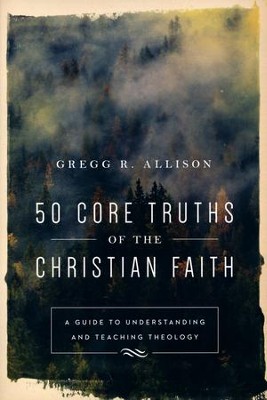
Book Review: 50 Core Truths of the Christian Faith, by Gregg R. Allison

What do I believe? This question is something that any Christian should ask himself. And in this book, Gregg Allison endeavors to help the Christian find that. His method is this: 1) understand the doctrine, 2) enact the doctrine, and 3) teach the doctrine. This is an effective method to not only know what we believe and why we believe it but also to be able to share those beliefs with others.

While he uses good methods, and many of the teachings are Biblically true, one of the problems of Allison's book is the inherent Calvinism in his teachings. While this does not affect every doctrine and teaching, it certainly affects teaching on salvation. While this is an ideal book to teach some other doctrines, believers are better off going elsewhere to specifically look for teachings on the doctrines that are affected by Calvinism, like salvation. For these reasons, I give this book 3 stars out of 5.

WHERE TO BUY THIS BOOK:

BIBLIOGRAPHY OF THIS BOOK:
Allison, Gregg R. 50 Core Truths of the Christian Faith: A Guide to Understanding and Teaching Theology. Grand Rapids, MI: Baker Books, 2018.

DISCLOSURE OF MATERIAL: I received a complimentary copy of this book through the Baker Book Bloggers book review program, which requires an honest, though not necessarily positive review. The opinions I have expressed are my own. 

Book Review: Nullifying God, by Dr. H. Robert Wilson, Ph.D.

We live in a world where evolution is widely accepted as scientific fact. Yet what viable evidence has been produced to confirm this? In all reality, evolution has remained a hypothesis, with little to no evidence to send it on to the status of a scientific theory, let alone a scientific fact. So what is the end game of evolution?

Dr. H. Robert Wilson, Ph.D., wrote Nullifying God as a response to evolution's claims. As a former evolutionist himself, he knows what they teach and believe. Now, after converting to Christianity, he knows why they believe what they do. In summary, evolution teaches what it does merely to mitigate Christianity and to nullify the God of the Bible. Why do they do this?

There is only one reason why these actions make sense for evolutionists-- power. Dr. Wilson writes, "Is evolution in effect pushing us to become independent of God? The answer is unequivocally 'yes.' (128)" This mentality keeps evolution in power and eliminates any responsibility that we have to God, along with conviction.

This book, while title Nullifying God did an excellent job at nullifying evolution. It presents good evidence for any layman to refute the claims of evolutionists, along with some arguments to defend our faith. Dr. Wilson's book is an excellent study in understanding what those who are against us believe so that we are prepared always to give an answer of the hope that lies within us. For these reasons, I award 5 stars out of 5 to this book.

WHERE TO PURCHASE:

BIBLIOGRAPHY OF THIS BOOK:
Wilson, H. Robert, Ph.D. Nullifying God: Evolution's End Game, A Scientist's Challenge. Greenville, SC: Ambassador International, 2017.

DISCLOSURE OF MATERIAL: I received a complimentary copy of this book through the Ambassador International book review program, which requires an honest, though not necessarily positive review. The opinions I have expressed are my own.