Saturday, December 23, 2017

Ezekiel: The Glory of God

In the book of Ezekiel, the prophet references the glory of God on a constant basis. He sees the glory of God in different times and places. In fact, I would say that a theme of Ezekiel is the glory of God. And yet, in this book, we see the glory of God leave.

In Ezekiel 10, the prophet Ezekiel is seeing a vision of the temple. This vision is renewing a vision of God that Ezekiel had seen in chapter 1. But now, the Lord's glory is leaving. With the assistance of four cherubim, God's glory slowly moves out of the temple.

God had dwelt in the temple since the beginning of the structure. He had resided over the mercy seat in the tabernacle when Israel was wandering in the wilderness. He then moved His glory into the temple during the dedication ceremony that Solomon had after the temple's completion. His glory resided in this structure as long as He could. But now Jerusalem was going to be destroyed, and along with it, the temple. And God's glory had to leave.

He first moved from the inner part of the temple to the threshold of the temple. He then moved to where the four cherubim were. From there, He moved to the east gate and finally left completely by the Mount of Olives.

It was then that Jerusalem was destroyed and the inhabitants were taken into captivity. Eventually, when they came back, they rebuilt the temple and resumed worship. But God's glory did not return at that time. God's glory could have returned at one time in history though.

The glory of God came and lived on the earth. Jesus Christ came to the earth and lived a perfect life as the Messiah. But Israel rejected Him. They rejected the very glory of God on this earth. Had they blown it completely? Had they lost all hope of ever seeing God's glory among them again?


Praise God they have not. Ezekiel prophecies of this in chapter 43. In this chapter, Ezekiel sees a vision of God's glory coming back into the city of Jerusalem. But when will this happen? Well, God will come to earth again at the conclusion of the Tribulation period. At this coming, He will set His feet down on the same place where He ascended from in Acts and the same place where the glory of the Lord left the first time: the Mount of Olives. He will come back into the city the same way the glory of God left: through the east gate, to the threshold of the new temple and dwell in the sanctuary there for a thousand years!! There are so many other details that I don't have time to write about, but it is a truly fascinating study!! God's glory will one day dwell on the earth again!!


Book Review: Jesus' Crucifixion Beatings and the Book of Proverbs, by David Wenkel

When I first received this book, I was intrigued. For those of you who have followed my blog, you know that I am in the middle of a series where looking at pictures of Christ all throughout the Bible. So seeing a book on a picture that I had not yet considered made me curious.

This book is based on the premise and principle of the beating of the fool in Proverbs being applied to the punishment that was inflicted on Christ on the cross. Through a look at multiple verses in Proverbs that advocate the beating of a fool who refuses to see reason, and through the establishment that when we sin, we are foolish, the author makes the argument that when Christ took our punishment through the stripes by the whip, he took on the beatings of the fools of this world.

The one downside to this book is that it is not an easy read for just a Bible study. It is an academic textbook, and as such, one must take great care to sit down, read it, study it, and get many of the concepts that are in it. If I could give a recommendation to the author, it would be to publish a second work which simplifies the argument for the reader. But to the dedicated seeker and student of the Bible, this will not be an issue.

This was a very interesting book to study. I do recommend it and will take even more time studying this book to attempt fully grasp the truths that lie within its pages through the interpretation of the Word of God. 

I will give this book 4 stars out of 5. While it is highly academic, it does show another good picture of Christ's sufferings for us and how He indeed paid the ultimate price for us.

WHERE TO BUY THIS BOOK:

BIBLIOGRAPHY OF THIS BOOK:
Wenkel, David H. Jesus' Crucifixion Beatings and the Book of Proverbs. Cham, Switzerland: Springer International, 2017.


DISCLOSURE OF MATERIAL: I received a complimentary copy of this book through the Springer book review program, which requires an honest, though not necessarily positive review. The opinions I have expressed are my own. 

Thursday, December 21, 2017

Easy, Legitimate Way to Receive Free Books!! -- UPDATE

For those of you who are looking for free books, an easy way to earn them is through Tyndale and NavPress's My Reader Rewards Club. 
You can access this club, and get a bonus 25 points to start off with through this link:
www.myreaderrewardsclub.com/login?pc=k7cw-905h-ilg8-pwpl-8g7b

Through sharing the program, referring others, completing *VERY* short surveys/quizzes, and reviewing Tyndale or NavPress products, you can earn points to put towards free books! 

UPDATE: After making my first request, I received my books about 2.5-3 weeks later. This is a great opportunity to get some good study materials!

Monday, December 18, 2017

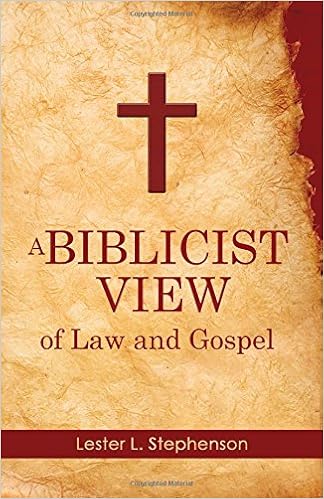
Book Review: A Biblicist View of Law and Gospel, by Lester Stephenson

Image result for A Biblicist View of Law and Gospel stephenson
What should our view be of the law? Some would say, live by a set of rules that define every aspect of your life. Others would say that the law no longer holds any bearing on our lives as Christians. But what should our view be? In A Biblicist View of Law and Gospel, Lester Stephenson attempts to find a balanced view of the law and the gospel.

Through looking at passages of the law, the prophets, the apostles, and Jesus Himself, Stephenson comes to a view of the law that is, as the title suggests, a biblicist view. This means that he does not look primarily at the teachings of other men. Rather, he goes directly to the Scriptures to dig out truths. Through this he is able to come to the conclusion, that the law and the gospel are indeed complementary. I do not want to spoil his arguments, but he makes several compelling arguments for why this is true.

For a truly Biblical look at the law of Moses in relation to the Gospel of Christ, I give this book 4 stars out of 5.

BIBLIOGRAPHY OF THIS BOOK:
Stephenson, Lester L. A Biblicist View of Law and Gospel. Greenville, SC: Ambassador International, 2017.

DISCLOSURE OF MATERIAL: I received a complimentary copy of this book through the Ambassador International blogger review program, which requires an honest, though not necessarily positive review. The opinions I have expressed are my own. 

Sunday, December 17, 2017

Book Review: A Confident Peace, by Dr. Mark Becton

I personally consider the book of Revelation to be my favorite book of the Bible. Ever since I first discovered the Left Behind series, I have been hooked on studying Bible prophecies. And A Confident Peace by Dr. Mark Becton is a very good book on this great book. 

Rather than merely looking at prophecies for the purpose of seeing their meaning, Dr. Becton looks at the book of Revelation as a book intended for application. His subtitle even shows this: Letting Revelation Change the Way You Live. And what's the premise of this? How can we allow this book change our lives? Dr. Becton shows this in his statement of what Revelation's purpose is: it "is God's message of hope to those who now suffer because of their surrender to Christ (20)."

Through this book, Dr. Becton's approach to studying Revelation shows something that we can all learn from. Revelation is an amazing book with many personal applications. I highly recommend this book for those who are looking to learn more about how to live now in the light of what is coming. I give this book 4.5 stars out of 5.

BIBLIOGRAPHY OF THIS BOOK:
Becton, Dr. Mark. A Confident Peace: Letting Revelation Change the Way You Live. Greenville, SC: Ambassador International, 2013.

DISCLOSURE OF MATERIAL: I received a complimentary copy of this book through the Ambassador International blogger review program, which requires an honest, though not necessarily positive review. The opinions I have expressed are my own. 

Saturday, December 16, 2017

Song Story: Mary, Did You Know?


Today's song story is a very special one, because with it comes a special video. The popular song "Mary, Did You Know?" was recorded by myself and a large number of other volunteer guys at Pensacola Christian College. Our group, One Accord, has performed many times on campus, as well as at a local air force base Hurlbert Field. There, we have performed the national anthem twice, once for the unveiling of a memorial, and once for a joint air force cross ceremony. We just released our debut music video on Wednesday, December 13.


So what is the story behind this beloved song? In an article that originally appeared on staugustine.com, we find the story:
“In 1984, Jerry Falwell called and asked me to write the program for their next Living Christmas Tree. 
As I wrote the ‘speaking parts’ I began to think about Mary. I have always been fascinated with the concept that God came to earth.
In a conversation with my mother, I remember she said, ‘If anyone on earth knew for sure that Jesus was virgin born — Mary knew!’ That was a profound statement that stuck with me.
One thing they couldn’t take from Mary was that she knew her Child was not ordinary.
At the cross on Mount Calvary, while Jesus was dying, her silence was a great testimony to the fact of who he was and is. He said to them, ‘When you have seen me, you have seen the Father.’ Of course, for this they nailed him to a cross, and his mother never said a word.
As my mind went back to the manger scene, I began to think about the power, authority and majesty she cradled in her arms. Those little lips were the same lips that had spoken worlds into existence. All of those things were contained in the young child lying quietly on her bosom. Even now, he was the very one who had given life to his mother, Mary.
I began writing a list of questions I would like to ask Mary if I could sit down with her — questions such as, ‘Mary, do you know who is in your arms?’
‘Did you know the one who holds creation together, and the one who holds you together is lying helpless in the manger?’
‘Did you know that your baby boy will walk on water, give sight to a blind man and calm a storm at sea with his hand?’”
Lowry carried his lyrics with him for the next seven years. In 1991, he asked his good friend, Buddy Greene, to write suitable music for his poem.
Greene told me in an interview, “Mark handed me his lyrics, and I held on to them for about two weeks. One day I pulled them out and looked at them. They seemed to suggest a minor key approach to writing an accompaniment. I completed the musical setting in about 30 minutes. I called Mark at his home in Georgia and on the phone played and sang the song to him. He was ecstatic! He said, ‘That’s it!’
Two weeks later. we met in Mark’s hotel room in Nashville where we recorded the song on a small portable machine. It was then taken to Michael English who was preparing to make an album. He was the first person to record “Mary, Did You Know?”
This song has become a Christmas favorite and a blessing to many. May its message carry on for years to come!!

The quoted portion of this article originally appeared here: http://staugustine.com/living/religion/2014-11-28/story-behind-song-mary-did-you-know

Friday, December 8, 2017

Book Review: Bearing Fruit, by Robby Gallaty

In this book, Robby Gallaty begins in his first chapter by looking at how truth grows, and then spends the rest of his book looking at the different types of fruit that we need to see in the church.

I do not want to give much away with this book, but seeing how much the author focuses on our relationship with Christ before we can produce any fruit is very encouraging. Without Christ we cannot do anything. We most certainly cannot grow in our faith.

He delves into great detail on producing fruit in our Christian life. These fruits are:
  • The fruit of repentance
  • The fruit of ministry
  • The fruit of sanctification
  • The fruit of righteousness
  • The fruit of good works
  • The fruit of the Spirit
  • The fruit of praise
Each of these fruits is important to see produced. Why is this? Because as Jesus said, "by their fruits ye shall know them (Matt. 7:20)." When we produce fruits, people will know who we are. Christians and non-Christians alike should see that we are followers of Christ.

To conclude the book, Gallaty includes a Bible study method, which has Bible reading and Scripture memory. This is an important part of growth in Christ and bearing fruit.

Gallaty does an excellent job of looking at the different types of fruit that we must produce in our lives by abiding in Christ. He writes in very simple terms that all Christians can understand. I recommend this book highly to help Christians grow and bear fruit, as the title would suggest, and give it 4.5 stars out of 5.

BIBLIOGRAPHY OF THIS BOOK:
Gallaty, Robby. Bearing Fruit: What Happens When God's People Grow. Nashville, TN: B&H Publishing, 2017.

DISCLOSURE OF MATERIAL: I received a complimentary copy of this book through the BH Bloggers book review program, which requires an honest, though not necessarily positive review. The opinions I have expressed are my own. 

Thursday, December 7, 2017

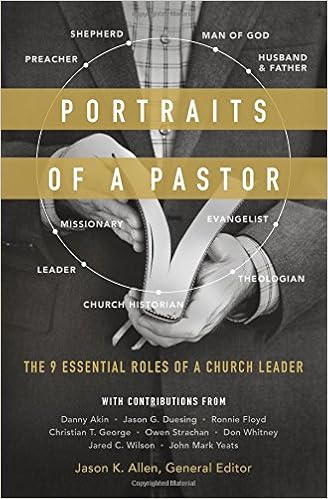
Book Review: Portraits of a Pastor, Jason Allen

Image result for portraits of a pastor jason allen
What is a pastor? What does he do? Is his job merely to get up in the pulpit and preach a sermon one to three times a week? In this book, Portraits of a Pastor, editor Jason Allen, along with eight other men, attempt to give the nine roles that a church leader should fill.

Jared Wilson writes of the role of shepherd. He believes that the role of the shepherd is the bare minimum role that a pastor should perform, as the word "pastor" is the equivalent of the word "shepherd."

Daniel Akin writes of the role of husband and father. He begins his chapter by saying, "I believe two of God's greatest gifts this side of heaven are marriage and family (33)." He encourages the pastor, and any man really, to love his wife and raise up his children.

Jason Allen writes of the role of preacher. He writes in his introduction, "I believe preaching is the pastor's preeminent responsibility (57)." He encourages the pastor to put out strong preaching straight from the Word of God

Owen Strachan writes of the role of theologian. Here, he focuses on the pastor's study of the Word. He encourages this study by saying, "The good news for us is that the good news works in us and through us (73)." The good news working in us is our personal study. It working through us is the teaching of that study.

Christian George writes of the role of church historian. He encourages the pastor to remember the past and take it with him into the future. Why does he encourage this? Because he believes that church history "encompasses the rest of [the disciplines of study]. Biblical studies, homiletics, philosophy, systematics, apologetics, counseling, and all other fields find their proper place beneath history's overarching reach (95)." No matter what, we cannot get away from the study of church history.

John Mark Yeats writes of the role of evangelist. The pastor must be reaching out to the local community. If he does not do this, the church will cease to grow. He must be telling all people about the good news of Jesus Christ.

Jason Duesing writes of the role of missionary. He encourages pastors to be "world Christians" and to push their congregations to be the same. Pastors must keep a global view of the ministry of God and stay involved with missions around the world.

Ronnie Floyd writes of the role of leader. He advocates that the pastor be part of a "brand;" something that gives him distinction in this world-- the brand of Jesus Christ.

Daniel Whitney writes of the role of man of God. He begins with a simple, yet profound statement: "Not every man of God is a pastor, but every pastor must be a man of God (161)." He also uses a very good illustration just a few sentences later: "Godliness is to the pastor what flight is to the eagle. Without personal godliness, the wings of pastoral ministry are broken (161)." Godliness is essential to every pastor's ministry.

Each of these writers, while having a different item to study, has the same purpose: to encourage pastors and to help them press on as better servants with a clearer vision of their role. Each role mentioned here is vitally important. Not one was explained in a weak manner. Having a different author for every chapter helped keep the roles strong. This is a very good book and helps pastors, especially new pastors, realize what role they need to fulfill. I give this book a rating of 5 stars out of 5.

BIBLIOGRAPHY OF THIS BOOK:
Allen, Jason K, General Editor. Portraits of a Pastor: The 9 Essential Roles of a Church Leader. Chicago, IL: Moody Publishers, 2017.

DISCLOSURE OF MATERIAL: I received a complimentary copy of this book through the MP Newsroom book review program, which requires an honest, though not necessarily positive review. The opinions I have expressed are my own. 

Saturday, December 2, 2017

A Biblical Approach to Entertainment

Image result for children playing video game
SOURCE: http://i.telegraph.co.uk/multimedia/archive/02362/video-game-2_2362669b.jpg


We live in an entertainment-driven culture. Everywhere you go--every village, town, city, and country--there is some form of entertainment. As Christians, figuring out what entertainment we can be involved in can be confusing. We are commanded to be in the world and not of it, and advised against a look at life that says "eat, drink, and be merry," but does that eliminate all entertainment?


The Bible does not give specific mandates or commands in regards to entertainment. But there are some principles that we can find in the Bible to establish a Biblical philosophy of entertainment. Each Biblical principle that I have found manifests itself in a question that should be asked of each form of entertainment. I will not be looking specifically at forms of entertainment that directly contradict the Bible, such as pornography, music with sexual content, or getting drunk. Rather I will be dealing with what I will call amoral entertainment, entertainment that in and of itself is not wrong. This may be television, music, movies, sports, or another form of entertainment like these. Let's jump right in!

1. How will this affect my relationship with God? (Prov. 21:17; II Cor. 6:14-15)
Proverbs 21:17 - He that loveth pleasure shall be a poor man: he that loveth wine and oil shall not be rich.
II Corinthians 6:14-15 - Be ye not unequally yoked together with unbelievers: for what fellowship hath righteousness with unrighteousness? and what communion hath light with darkness? And what concord hath Christ with Belial? or what part hath he that believeth with an infidel? And what agreement hath the temple of God with idols? for ye are the temple of the living God; as God hath said, I will dwell in them, and walk in them; and I will be their God, and they shall be my people.

Our relationship with God should be paramount whenever we consider participating in a certain form of entertainment. God should always be first in our lives. This is the principle behind Proverbs 21:17. This verse does not speak of the man who enjoys going to a baseball game once in a while or the woman who enjoys watching her weekly television shows. This verse is speaking of the man who puts his sports above God or the woman who lets her tv replace her relationship with God. While a form of entertainment may be good in some respects, it becomes wrong when God is below that entertainment.

In II Corinthians 6, we see a series of contrasts of good things and bad:
• Righteousness vs. Unrighteousness
• Light vs. Darkness
• Christ vs. Belial (Satan)
• The Believer vs. The Infidel
• The Temple of God vs. The Temple of Idols
Each of these contrasts leaves us with the same question: do we have a relationship with God or the world? Again, is our relationship with God first in our hearts rather than our relationship with the things that self wants. If participating in an activity takes our focus off our relationship with God, we must not participate. If going to a sporting event turns someone into a cursing maniac, should he go? No. If watching cable tv tempts one to pay for a channel that he knows he should not watch, should he get rid of cable? Absolutely. The things that hinder my relationship with God may be different than yours. We must each safeguard our relationship with God individually.

2. How will this affect my mind and my thoughts? (Phil. 4:8)
Philippians 4:8 - Finally, brethren, whatsoever things are true, whatsoever things are honest, whatsoever things are just, whatsoever things are pure, whatsoever things are lovely, whatsoever things are of good report; if there be any virtue, and if there be any praise, think on these things.

Stemming directly from our relationship with God is the question of how entertainment affects our thoughts. Our thought life is the hardest part of our lives to control. When God saw man in Noah's day, he judged them not only because what they did was evil, but also because "every imagination of the thoughts of his heart was only evil continually." Man's thoughts must be controlled and must be good.

Paul advocates this control of the mind in this verse. He wants the people who read his letter to have true, honest, just, pure, lovely, honorable, virtuous, and praiseworthy thoughts. If their thoughts did not line up with these characteristics, he wanted to help them change. Not for his sake or because he said so, but because it is honoring and pleasing to God to have good thoughts.

3. How will this affect my relationship with others? (I Cor. 8-9; 10:31-33)
I Corinthians 10:31-33 - Whether therefore ye eat, or drink, or whatsoever ye do, do all to the glory of God. Give none offence, neither to the Jews, nor to the Gentiles, nor to the church of God: Even as I please all men in all things, not seeking mine own profit, but the profit of many, that they may be saved.

While we must each take our own relationship with God and our own thoughts into account, we must also take into account the relationship with God and thoughts of others. In I Corinthians, Paul addresses one of the many issues that had come up in the Corinthian church. Some members of the church saw nothing wrong with eating meat offered to idols. Others believed that this was an act of worship of those same idols. Paul himself said that the eating of that meat was not necessarily a sin. Here, however, is the sin: when someone who was ok with eating that meat became a stumblingblock to those who was not ok with it. As Christians, they had the liberty to eat that meat. Some knew, as Paul did, that it was not sin. But Paul pronounced a great principle in the last verse of chapter 8: "Wherefore, if meat make my brother to offend, I will eat no flesh while the world standeth, lest I make my brother to offend." Paul was willing to never eat meat again if it meant that he did not cause his Christian brothers and sisters to sin. 

What about us? Is there a bigger "meat offered to idols" situation in Christian circles today than entertainment? There are many forms of entertainment that we can participate in, and, as I mentioned previously, the things that hinder our relationship with God should be banished from our lives. But we must also be aware that there are those who have different standards than we do. And we must be careful not to violate their standards and their conscience.

Let me illustrate this principle from my own personal experience. Growing up, I was not allowed to listen to any contemporary music at all. It was the standard that my family held to. As I grew older, my mom started allowing me to make some of my own choices as far as music, as long as I did not violate Biblical principles. However, while I was allowed to listen to more contemporary music in my personal life, I was not allowed to listen to all of this around my dad or my grandfather. Not because it was bad. Not because they would hate me for it. But because they hold to a different standard, and I would violate their convictions. 

4. Is this an appropriate time for this activity? (Ecc. 3:1-8)
Ecclesiastes 3:1-8 - To everything there is a season, and a time to every purpose under the heaven: A time to be born, and a time to die; a time to plant, and a time to pluck up that which is planted; A time to kill, and a time to heal; a time to break down, and a time to build up; A time to weep, and a time to laugh; a time to mourn, and a time to dance; A time to cast away stones, and a time to gather stones together; a time to embrace, and a time to refrain from embracing; A time to get, and a time to lose; a time to keep, and a time to cast away; A time to rend, and a time to sew; a time to keep silence, and a time to speak; A time to love, and a time to hate; a time of war, and a time of peace.

This final question takes right after the previous one in the issue of using discernment in choosing our entertainment. Rather than the who this time though, we will be dealing with the when. There will be some occasions where a form of entertainment is appropriate and other times when it is not. For example, it is not appropriate to be listening to the 4th quarter of the Alabama-Auburn football game during your great-aunt's funeral. And it is definitely not appropriate for a man to be scrolling through his news feed on his phone while his bride is walking down the aisle. Those things can be good at an appropriate time but are extremely detrimental when used in the wrong context.

CLOSING THOUGHTS
What does this mean for our entertainment? First, it means that there is no definite answer to what will be right as far as entertainment goes, nor will there ever be any standard that is 100% right for every person. Second, it means that we must form convictions about entertainment that follow Biblical principles. God has written down many principles in this world that He wants us to follow. It is now that through careful study and prayer that we must form our convictions. Finally, we must use discernment in our use of entertainment, with who we use it around and when we use it.

Thursday, November 30, 2017

Book Review: "Your Guide to the Apocalypse", by Matt Hagee

Jesus is coming again. We know this as believers. The church has been taught this fact for years since He left the earth. His disciples were told by angels when He ascended, "Ye men of Galilee, why stand ye gazing up into heaven? this same Jesus, which is taken up from you into heaven, shall so come in like manner as ye have seen him go into heaven (Acts 1:11, KJV)."

Since that time, the study of Christ's return has been one that has consumed men. God used men here on earth: Paul, John, Daniel, Ezekiel, and Jesus Himself to teach on the end times. Now that we have the Bible, men are constantly attempting to interpret prophetic passages. Matt Hagee endeavors to do this in this book, Your Guide to the Apocalypse.

Hagee does a good job of looking at the events leading up to the events of Scriptures teaching. This book, while it does look at some events of the Tribulation, is more of a stage setter for what is to come. And I like that about this book. Because the truth is, if we are truly saved, we will not be here. Our goal is to win souls to Christ before He comes back. The worries of the gospel in the Tribulation will be put back on Israel through the 2 witnesses and through the 144,000 witnesses (see Revelation 7 and 11 for more details on those).

I also appreciate his look at the letters to the 7 churches in the book of Revelation. These letters are so often overlooked in studies of the book, but they are very important letters. God put them there for the benefit of the churches then, but also the churches now.

As I have said, I greatly appreciate Matt Hagee's take on the build-up to the prophetic events and the addressing of the letters to the 7 churches. I would recommend this book to one who is curious of what is to come. I would also like to issue a caution that is true with any Biblical topic, but specifically eschatology (the study of the end times)-- be extremely careful to take a look at God's Word while reading this book. Look up and study the Scriptures for yourself along with this book. This is merely a guide. God wants us to study the Word for ourselves too.

I'll give 4.5 stars out of 5 for a good guide to what is coming.

BIBLIOGRAPHY OF THIS BOOK:
Hagee, Matt. Your Guide to the Apocalypse: What You Should Know Before the World Comes to an End. Colorado Springs, CO: Waterbrook, 2017.


DISCLOSURE OF MATERIAL: I received a complimentary copy of this book through the Blogging for Books book review program, which requires an honest, though not necessarily positive review. The opinions I have expressed are my own. 

WHERE TO PURCHASE: https://waterbrookmultnomah.com/books/544966/your-guide-to-the-apocalypse-by-matt-hagee-foreword-by-john-hagee/